Lao villages are something to behold. We spent a few days in the towns of Luang NamTha and Muang Sing in the northwest of Laos, getting some exercise and enjoying the scenery and people of the surrounding villages. Biking through some of the villages leaves us with the distinct impression that it is the year 1901 and have just 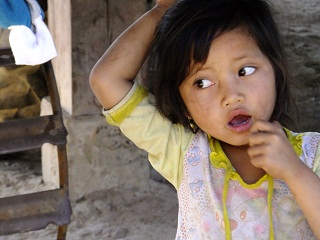 somehow crossed an imaginary time warp line. This, of course, is why we find them so fascinating. People are just going about their daily lives. Lives which include husking grassy branches to make brooms, shaking the kernels from the rice grains, spreading out chilies on a bamboo plate to dry in the sun, bathing under a communal tap or just sitting on their doorstep watching village life flit by. Villages are always full of young kids chasing chickens, putting the death grip on an endless number of puppies, collecting bees in plastic bags, spinning tops and crawling in boxes. We think the best way to venture through the out-of-the-way villages is on a bike, and rent bicycles (in various stages of disrepair) most places we visit. Older kids go to school during the day, so if you are lucky enough to pedal through their village after they have arrived home, you will be met with an endless stream of 'Hello! Good Morning!' (in the evening) or 'Good Afternoon, Teacher!' (in the morning). Judging by the burst of uncontrollable laughter that follows these words, this is the funniest joke in Lao. You can't help but laugh along. They then continue to jump up and down, sometimes chasing after us, laughing, and yelling out any random English words they know.

The roads that snake through the villages, past the tidy wood houses, are dusty. I can imagine that in the rainy season, 'playing in the mud' is an activity topping a child's list of 'things to do today.' Kids climb to the top of trees so that they can call welcoming words from the heavens (and there-by causing anyone on a bike to swerve into head-on traffic in surprise). We rented bikes in Luang NamTha and were headed down one of the main roads around noon and were met with an entire school's worth of kids on their pedal home for lunch. They sped up to pass us and shout, 'Hello!' and then slow down so we could catch up and they could yell 'Hello!' yet again. One of the cheeky boys decided that simply using us for English practice was not enough. He wanted a free ride. So, he grabbed onto Jonathan's shoulder and let Jonathan pull him along, laughing gleefully the whole time. He had it all figured out. I tried the same trick later that day, with considerably less success. The kids departed on a helpful note, pointing us down a side path back to town.
Life goes on in plain view in these villages. No one is concerned with closing the blinds in the evening so passerbys can't glance in and catch them watching TV. One, because there aren't blinds, just big wood shutters that close at night to keep the mosquitos and light at bay, and two, because there aren't TVs. But you get the picture. Biking through a village you feel apart of every-day life. Women wearing sarongs bathe under the communal tap, using buckets to pour the water over their hair. Men sit on little stools, watching in a pink Barbie mirror while their wives cut their hair. The older generation sits on their stoops while their grandchildren frolick among the chickens and swing cats around by their ears. Women weave skirts on huge looms and men gather around the various contraptions and pots, stirring their batches of rice whiskey under experienced eyes. For us, this life is intriguing. It's hard to look away. They have so much less (stuff wise), but looking around, it's sometimes impossible to see how our 'stuff' would fit in. It's so simple and refreshing. What? People survive without perfectly manicured lawns and white picket fences to separate 'mine' from 'yours'? You share a bedroom with who? Most of the
 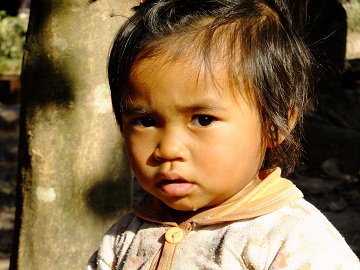 time, the best part of the villages are it's friendly residents. You can't be upset when everyone is smiling at you. You almost get the feeling that you pedalled backwards into a different time; when weary travellers were welcomed warmly into family homes and taken care of while they were passing through.
Almost as nice as the villages themselves is the scenery you pedal past between the villages. Emerald green rice fields, dotted with bamboo shelters stretch out in front of us to the backdrop of looming Burmese and Chinese mountains in the distance. It's an absolutely perfect way to spend a morning or late afternoon. It's far too hot, and the sun is too strong to be out mid-afternoon. We take that as unofficial siesta time!
Although most villages are a pleasure to visit, it most certainly is not a blanket statement. The residents of each village belong to their own tribe. Some villages are more fond of visitors than others. Fair enough. We have noticed this more so in Lao. People are either super smiley and friendly, or they don't even acknowledge your existence when you greet them. Maybe they are just naturally reserved, but maybe there is a reason that they distrust outsiders. It's hard to say.
What we do know, is that outside influence, regardless of how well-intended it was to begin with, isn't always a positive thing for these villages. Is our visiting encouraging people to keep their traditional way of life, or is it encouraging every single person in the village to take up making tacky bracelets, because sometimes tourists come through and buy them? Or when you give that cute kid a few dollars and then they return home to their parents who have been working hard all day to earn half that amount. That can't be good for Dad's pride, which is important in these parts. And, if they can forgo the pride issue then why not send little Jimmy (not Jimmy the Rice Hat) out again tomorrow to see who will dole out some cash to him. It's not like going to school is important. Or how about just giving him candy? Because that's super helpful for kids in a country where not everyone has access to modern dentistry or maybe even knowledge of dental hygiene. Oh, and look, there's all those plastic candy bags floating down the river past us. True (and sad) eye-witness story. Anyways. When we were in Luang NamTha, which is a popular town from which to organize treks, we were constantly being followed by older women, dressed in traditional hilltribe clothing begging us incessantly to buy their seashell bracelets. Lao is landlocked. Clearly seashell bracelets are not some kind of traditional village craft. 'No', didn't work. Neither did 'no thank you' (in any language). Nor did, 'Don't need one' (Of course you do!) or 'No room in my bag,' (It's so small) or 'It's not my colour,' (Then it would look great on your travel companion, or a passing dog for all the seller cares) or 'I don't like it' (It doesn't matter what you like) or even the outright lie, 'I already have one' (Two is better than one...or three for that matter). The women would stand over us, our entire meal, having laid out their offerings down the middle of our table, moving any pesky condiments far out of the way, mumbling and pushing the bracelets onto our wrists. When that didn't work, they tried whispering, the secret code for selling opium, we found out. When some (stupid) tourist would give in and buy a bracelet for about twenty five cents, the real trouble would begin. More ladies would appear, apparating from the thin air, arms stocked with bracelets, sashes, belts and sarongs. They would then proceed to cover e
 very inch of the (dumb) buyer's table with every single thing they had. Because, of course, buying one thing was never going to be enough. Literally surrounded by increasingly persistent Akha Ladies (they are always from the Akha tribe) most people would have to resort to changing tables just so that they would have somewhere to put their food when it arrived. At least it took the pressure off us for a few bites... It got to the point where we were so annoyed we would just outwardly ignore them. But then I would feel guilty. What the heck were we doing? We are the ones who came all the way to Lao to 'experience the culture,' and here was a Laotian, literally shoving it in our faces and we wanted absolutely nothing more than for it to just go away. We asked the man at our guest house. It turns out that these ladies are annoying for everyone, including locals (at least we weren't the only ones!) They leave their village and come to the town to sell to tourists, they sleep on the tables set out for the market that night and completely desert their roles in their home villages. It is a real social problem in this part of Lao. All this to say, 'The more you learn, the more complicated everything becomes.' Isn't it supposed to be the opposite way around?
somehow crossed an imaginary time warp line. This, of course, is why we find them so fascinating. People are just going about their daily lives. Lives which include husking grassy branches to make brooms, shaking the kernels from the rice grains, spreading out chilies on a bamboo plate to dry in the sun, bathing under a communal tap or just sitting on their doorstep watching village life flit by. Villages are always full of young kids chasing chickens, putting the death grip on an endless number of puppies, collecting bees in plastic bags, spinning tops and crawling in boxes. We think the best way to venture through the out-of-the-way villages is on a bike, and rent bicycles (in various stages of disrepair) most places we visit. Older kids go to school during the day, so if you are lucky enough to pedal through their village after they have arrived home, you will be met with an endless stream of 'Hello! Good Morning!' (in the evening) or 'Good Afternoon, Teacher!' (in the morning). Judging by the burst of uncontrollable laughter that follows these words, this is the funniest joke in Lao. You can't help but laugh along. They then continue to jump up and down, sometimes chasing after us, laughing, and yelling out any random English words they know.The roads that snake through the villages, past the tidy wood houses, are dusty. I can imagine that in the rainy season, 'playing in the mud' is an activity topping a child's list of 'things to do today.' Kids climb to the top of trees so that they can call welcoming words from the heavens (and there-by causing anyone on a bike to swerve into head-on traffic in surprise). We rented bikes in Luang NamTha and were headed down one of the main roads around noon and were met with an entire school's worth of kids on their pedal home for lunch. They sped up to pass us and shout, 'Hello!' and then slow down so we could catch up and they could yell 'Hello!' yet again. One of the cheeky boys decided that simply using us for English practice was not enough. He wanted a free ride. So, he grabbed onto Jonathan's shoulder and let Jonathan pull him along, laughing gleefully the whole time. He had it all figured out. I tried the same trick later that day, with considerably less success. The kids departed on a helpful note, pointing us down a side path back to town.
Life goes on in plain view in these villages. No one is concerned with closing the
blinds in the evening so passerbys can't glance in and catch them watching TV. One, because there aren't blinds, just big wood shutters that close at night to keep the mosquitos and light at bay, and two, because there aren't TVs. But you get the picture. Biking through a village you feel apart of every-day life. Women wearing sarongs bathe under the communal tap, using buckets to pour the water over their hair. Men sit on little stools, watching in a pink Barbie mirror while their wives cut their hair. The older generation sits on their stoops while their grandchildren frolick among the chickens and swing cats around by their ears. Women weave skirts on huge looms and men gather around the various contraptions and pots, stirring their batches of rice whiskey under experienced eyes. For us, this life is intriguing. It's hard to look away. They have so much less (stuff wise), but looking around, it's sometimes impossible to see how our 'stuff' would fit in. It's so simple and refreshing. What? People survive without perfectly manicured lawns and white picket fences to separate 'mine' from 'yours'? You share a bedroom with who? Most of the time, the best part of the villages are it's friendly residents. You can't be upset when everyone is smiling at you. You almost get the feeling that you pedalled backwards into a different time; when weary travellers were welcomed warmly into family homes and taken care of while they were passing through.Almost as nice as the villages themselves is the scenery you pedal past between the villages. Emerald green rice fields, dotted with bamboo shelters stretch out in front of us to the backdrop of looming Burmese and Chinese mountains in the distance. It's an absolutely perfect way to spend a morning or late afternoon. It's far too hot, and the sun is too strong to be out mid-afternoon. We take that as unofficial siesta time!
Although most villages are a pleasure to visit, it most certainly is not a blanket statement. The residents of each village belong to their own tribe. Some villages are more fond of visitors than others. Fair enough. We have noticed this more so in Lao. People are either super smiley and friendly, or they don't even acknowledge your existence when you greet them. Maybe they are just naturally reserved, but maybe there is a reason that they distrust outsiders. It's hard to say.
What we do know, is that outside influence, regardless of how well-intended it was to begin with, isn't always a positive thing for these villages. Is our visiting encouraging people to keep their traditional way of life, or is it encouraging every single person in the village to take up making tacky bracelets, because sometimes tourists come through and buy them? Or when you give that cute kid a few dollars and then they return home to their parents who have been working hard all day to earn half that amount. That can't be good for Dad's pride, which is important in these parts. And, if they can forgo the pride issue then why not send little Jimmy (not Jimmy the Rice Hat) out again tomorrow to see who will dole out some cash to him. It's not like going to school is important. Or how about just giving him candy? Because that's super helpful for kids in a country where not everyone has access to modern dentistry or maybe even knowledge of dental hygiene. Oh, and look, there's all those plastic candy bags floating down the river past us. True (and sad) eye-witness story. Anyways. When
we were in Luang NamTha, which is a popular town from which to organize treks, we were constantly being followed by older women, dressed in traditional hilltribe clothing begging us incessantly to buy their seashell bracelets. Lao is landlocked. Clearly seashell bracelets are not some kind of traditional village craft. 'No', didn't work. Neither did 'no thank you' (in any language). Nor did, 'Don't need one' (Of course you do!) or 'No room in my bag,' (It's so small) or 'It's not my colour,' (Then it would look great on your travel companion, or a passing dog for all the seller cares) or 'I don't like it' (It doesn't matter what you like) or even the outright lie, 'I already have one' (Two is better than one...or three for that matter). The women would stand over us, our entire meal, having laid out their offerings down the middle of our table, moving any pesky condiments far out of the way, mumbling and pushing the bracelets onto our wrists. When that didn't work, they tried whispering, the secret code for selling opium, we found out. When some (stupid) tourist would give in and buy a bracelet for about twenty five cents, the real trouble would begin. More ladies would appear, apparating from the thin air, arms stocked with bracelets, sashes, belts and sarongs. They would then proceed to cover every inch of the (dumb) buyer's table with every single thing they had. Because, of course, buying one thing was never going to be enough. Literally surrounded by increasingly persistent Akha Ladies (they are always from the Akha tribe) most people would have to resort to changing tables just so that they would have somewhere to put their food when it arrived. At least it took the pressure off us for a few bites... It got to the point where we were so annoyed we would just outwardly ignore them. But then I would feel guilty. What the heck were we doing? We are the ones who came all the way to Lao to 'experience the culture,' and here was a Laotian, literally shoving it in our faces and we wanted absolutely nothing more than for it to just go away. We asked the man at our guest house. It turns out that these ladies are annoying for everyone, including locals (at least we weren't the only ones!) They leave their village and come to the town to sell to tourists, they sleep on the tables set out for the market that night and completely desert their roles in their home villages. It is a real social problem in this part of Lao. All this to say, 'The more you learn, the more complicated everything becomes.' Isn't it supposed to be the opposite way around?
 long is it going to take to get from here to there, there to here. One never can say for certain. We were in Mae Saelong, in Thailand and were hoping to cross the Laos border and then make it a few hours north up to Luang NamTha that same day. We really had no idea if it was possible or not. I suppose it's just all part of the adventure. Can you imagine me (especially) living like this at home? Who knows where we will sleep tonight? Somewhere between here and there...
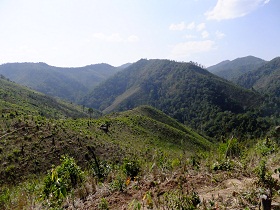 the spine of a mountain is spectacular. On either side of the road the land gives way to steep slopes now mostly lined with tea plants. Every which way you look you see lovely lush hills in the foreground and the distant majestic mountains of Burma or China in the background. Houses, shops and restaurants cling to the edge of the mountain, rooted in the rock on the one side and supported by bamboo stilts on the other. Every house has a breathtaking view. The downside of being on the spine of a mountain is the getting there. Hair pin turns switch back and forth, back and forth, up, up, up the terrifying, yet beautiful mountain range. Once you're at the top, there's no where to go but down. Really down. Down, down down. This thought doesn't seem to even enter the minds of locals as they fly down the streets helmet-less on their motorbikes (see our Flickr photos on the right).
 With an early morning, ninety minute songtheaw ride back down through the mountains with a old lady who spit out the window every thirty seconds and a couple of babies who stared at Jonathan's beard like it was about to jump off his face and attack them. (Although, really, who knows whats living up there in that crazy facial bush these days). The songtheaw pulled up alongside another songtheaw in a backstreet village and our bags were hoisted from one roof to another and we switched to another songtheaw for the duration of our journey to Chiang Rai. From Chiang Rai we hopped a bus to Chang Khong, on the Laos border. We were dropped off on the side of the street, conveniently in front of the tuk tuk hang out so that we could pay them a bit to drive us further down the street to where the tiny eight-seater long tail boats waited to take us across the river to Laos. Really, the bus could have dropped us off at the end of the street next to the boat pier, but then what would all these tuk tuk drivers have to do all day? We paid the boat guy far too much to take us for a sixty second jaunt across the river where we then waded through the mud to get to the landing.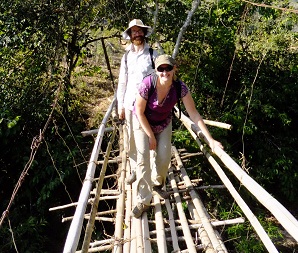

 ring up Mr. Harper and request that he pen a letter offering Canada's sincerest, deepest apologies to Laos, for whatever our wrong-doings may have been, and send it off straight away. Oh, and would he mind sending our $28 refund cheque to....


 out our driver morphed into Mario Andretti playing a racing video game. It must have been a game, because there is no way anyone in real life, with real 'live' people as passengers would drive like this. Because you come very close to feeling like you are going to die. And generally I wouldn't pay money for that sort of thrill. He took the ninety degree turns at the perfect speed to get up on two wheels at every possible opportunity. The curves were so tight that he had to use all his body weight to make the steering wheel turn. He was a little guy. I know this because I was sitting directly behind him and watched in fear as his torso would swing into the passenger seat when we turned right and practically out the window when we swerved left. Seriously: picture a little kid playing a car racing game.