We were hiking up past the monastery in Litang to the grassy hills behind it when we were approached by a monk. He was smiley and friendly and couldn't speak a lick of English. From his wild hand motions in the direction of my camera, I could tell that he wanted us to take his photo. Ok. I was the tinsiest bit apprehensive as most people who request to have their photo taken (other than Han Chinese who want to pose in photos with us) ask us for money after we have gone ahead and taken their photo. But Litang has been different in so many aspects, and this seemed to be another one. So I took his photo.

He wanted to see it. He was mildly pleased, but wasn't completely satisfied. He wanted another. He posed. I snapped. Who am I to turn down such a fantastic photo opp? A monk's saffron and maroon robes set against the colbalt blue sky? Click. Click. He posed more. He pretended to read my little notebook. He pretended to meditate, to pray. It was entertaining. Mostly for myself and the monk though. Not so much for Jonathan, as he was left to fend off all the salivating stray dogs on his own, while protecting all the monk's belongings that the monk had dropped into his arms.
 The real question was, why was the monk so adament that I take a slew of photos of him? We were finally able to slip away and go on the hike that we were intending to go on. On the way back down the hill, however, we were spotted by the model monk and chased down. Quite literally. He wanted more photos. After each time I took a picture, he would inspect it. He rubbed his greasy fingers all over the screen and pointed out various ways I could improve my shot. He kept pointing to the sky 'tuga,' 'tuga' he said over and over. That's what it sounded like anyways. Finally I got the idea that what he wanted was a photo of him and just the sky. I tried to convince him that because we were standing on a hill, with the ground rising up behind him, that a photo of
 his whole body surrounded by blue sky would be impossible. 'Tuga!!' So we went further up the hill. He framed the shots with his fingers to try and show me exactly what he wanted. Nearly a half hour later I finally managed to take a photo that he was happy with. But the question remained: 'what did he want me to do with this acceptable photo?' I tried writing down my email address and giving it to him so I could email him the photos. That didn't seem to be what he was going for. He wrote something in Tibetan in my notebook. I don't know how familiar you are with the Tibetan language- but it might as well be morse code with all the incomprehensible lines and dots. Did he want me to mail him the photos? I couldn't see how well that would go. I copy the
 Tibetan down on to the envelope and just drop the package in the mail? How far could it possibly get? Do I write, 'Tibetan monk, Litang Monastery, Middle of no-where, China,' on the envelope? I began to wonder if he wanted the camera. I got the idea that perhaps he wanted me to take my camera down to the village and somehow bring him back up prints. Apparently he wasn't aware where he was. Yaks were the main traffic. There was no Walmart photocentre. There were barely flush toilets. I brought his message down to the owner of our guesthouse, who was also Tibetan in hopes of shedding some light on his mysterious message. 'This doesn't make any sense,' she told me gravely, shaking her head. 'He doesn't write Tibetan very well at all.' So, maybe he wanted the photos to be displayed on our blog? That must be it.
were approached by a monk. He was smiley and friendly and couldn't speak a lick of English. From his wild hand motions in the direction of my camera, I could tell that he wanted us to take his photo. Ok. I was the tinsiest bit apprehensive as most people who request to have their photo taken (other than Han Chinese who want to pose in photos with us) ask us for money after we have gone ahead and taken their photo. But Litang has been different in so many aspects, and this seemed to be another one. So I took his photo.He wanted to see it. He was mildly pleased, but wasn't completely satisfied. He wanted another. He posed. I snapped. Who am I to turn down such a fantastic photo opp? A monk's saffron and maroon robes set against the colbalt blue sky? Click. Click. He posed more. He pretended to read my little notebook. He pretended to meditate, to pray. It was entertaining. Mostly for myself and the monk though. Not so much for Jonathan, as he was left to fend off all the salivating stray dogs on his own, while protecting all the monk's belongings that the monk had dropped into his arms.
The real question was, why was the monk so adament that I take a slew of photos of him? We were finally able to slip away and go on the hike that we were intending to go on. On the way back down the hill, however, we were spotted by the model monk and chased down. Quite literally. He wanted more photos. After each time I took a picture, he would inspect it. He rubbed his greasy fingers all over the screen and pointed out various ways I could improve my shot. He kept pointing to the sky 'tuga,' 'tuga' he said over and over. That's what it sounded like anyways. Finally I got the idea that what he wanted was a photo of him and just the sky. I tried to convince him that because we were standing on a hill, with the ground rising up behind him, that a photo of his whole body surrounded by blue sky would be impossible. 'Tuga!!' So we went further up the hill. He framed the shots with his fingers to try and show me exactly what he wanted. Nearly a half hour later I finally managed to take a photo that he was happy with. But the question remained: 'what did he want me to do with this acceptable photo?' I tried writing down my email address and giving it to him so I could email him the photos. That didn't seem to be what he was going for. He wrote something in Tibetan in my notebook. I don't know how familiar you are with the Tibetan language- but it might as well be morse code with all the incomprehensible lines and dots. Did he want me to mail him the photos? I couldn't see how well that would go. I copy the Tibetan down on to the envelope and just drop the package in the mail? How far could it possibly get? Do I write, 'Tibetan monk, Litang Monastery, Middle of no-where, China,' on the envelope? I began to wonder if he wanted the camera. I got the idea that perhaps he wanted me to take my camera down to the village and somehow bring him back up prints. Apparently he wasn't aware where he was. Yaks were the main traffic. There was no Walmart photocentre. There were barely flush toilets. I brought his message down to the owner of our guesthouse, who was also Tibetan in hopes of shedding some light on his mysterious message. 'This doesn't make any sense,' she told me gravely, shaking her head. 'He doesn't write Tibetan very well at all.' So, maybe he wanted the photos to be displayed on our blog? That must be it.

 The sky burial itself makes practical sense for Tibetans. In Tibet, even if the land wasn't frozen most of the year, and could be dug up, the Tibetan landscape is scarce. There is no dirt to bury their dead and there is hardly a tree to be cut for a cremation. Every bit of wood needs to be used for domestic heating and cooking.
 mixing in a powder with the increasingly pulverized bones. The powder is then used to feed the crows that are also lurking nearby, waiting for their turn to take part in the feast. This wasn't the only action, though. There were three bodies being given a sky burial the morning we were there.
 The sky was a magnificent blue, the clouds were as marshmallows and the mountains impressively chiseled in every direction we looked. All in all this will be a memorable day for us. It gives a new perspective to the age old 'ashes to ashes, dust to dust.' bit heard at many Christian funeral services. Mulling over that well known phrase, I couldn't help but keep a short poem from creeping into my (Jonathan) head:
 town, sits just a couple mountain ranges to the east, and 80% of its population is Tibetan. The difference is obvious and immediately noticable. It feels different, it looks different, the people are different, the language is different, the food is different, the architecture is different. Litang is colourful, friendly, lively, devout - and crawling with police. Yup. We are practically in Tibet.
 around town, their music blaring, their long, black hair flowing behind them. They wave and shout greetings enthusiastically. 'Tashi Delik! Ni Hao! Hello!' Sometimes we respond with a bonjour, just to cover another language. And thats the extent to which we can communicate. Saying 'hello' in multiple languages. This doesn't seem to deter anyone in the slightest.
 the Tibetan kids. They shout their greetings, if they are old enough to talk, or waddle on up to us to play. Like I said - Tibetans are tough.
 'momos' because they had a funny name. Now they were a hit. Essentially, momos are Tibetan perogies - big crunchy/doughy pockets stuffed with (in this case) potato and spring onions- and served with spicy dipping sauce. Delicious.
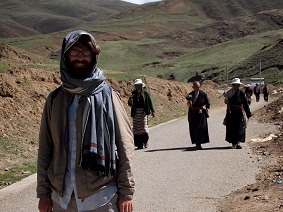
 monastery, and UP around behind it! We were bent over, gasping for the limited oxygen every ten steps and the elderly Tibetans would cruise past us, mumbling prayers, working their way through the prayer beads in one hand, and spinning their prayer wheel in the other! Of course, they would stop to greet us, smile and chuckle at our state, but they would then continue on, up the path like they were on some sort of relaxing Sunday stroll.
 We stopped in at the monastery in the early afternoon and had the pleasure of watching the young monks 'debate.' It doesn't look like you would think. The monks are paired up. One is sitting on the ground, cross-legged, book in hand. The other is performing a complicated, beautiful set of movements, which, from what we can tell, end in that monk posing a question to the sitting monk. The deep maroon robes of the dozens of monks 'debating' set against the spectacularly blue sky, high on the roof of the monastery was just magic.
 the brave, young monk hadn't been bitten (J: I tried!), or been the victim of any other serious injury from the scary, hairy guy, the group deemed it safe to inch even closer. Jonathan smiled and invited them to sit next to him on the ledge. That was all it took. The group rushed over and took turns tugging on Jonathan's (overgrown) red beard, laughing and discussing how much Jonathan's beard looks like an unruly Chairman Mao's (as interpretted by myself). Other monks saw all the fun and rushed over to crowd around. And again, almost instantly, Jonathan had grown a fan club. Who needs to be able to communicate when you have a big, bushy beard? The facial hair is large, unruly and red enough to be a personality all on it's own. Although, lately, this particular beard is also growing a bit of an ego. Apparently it's looking for it's own blog entry- The beard- a bridge between cultures. Wonder what a little scissor action would do to it's confidence?
 Wandering up the hill, through the traditional Tibetan village on the way to the monastery was so eye-openingly Tibetan, and absolutely fantastically photogenic. Unfortunately yanking my camera out seemed completely inappropriate. There was no way this village was in AD 2011. The buildings were stone but ornate with the window and door frames colourfully painted. Older people, without teeth, dressed in colourful, but sensible clothes sat under stone archways, working their way through their prayer beads, watching children with wild black hair play in the dirt. It was so authentic. Everyone smiled and waved. The kids shouted their greetings until we were out of sight. At one point, in front of a particularily peel-y, atmospheric white building with colourful Tibetan curtains about twenty older people sat together, watching the world pass them by on the street, all smiling toothlessly, chanting and swinging their prayer wheels. Wow. I don't even know how many times I pretended my eyelids were the camera shutter, and squeezed them shut trying to etch the images into my brain. It really was just fantastic.
 would dictate, it started to rain literally the second we started to head back. Apparently the rain also made the already aggressive stray dogs even hungrier for blood. They chased us back to the house by the hot spring. The young Tibetan girl smiled and led us inside to the wood stove where who appeared to be her mother and grandmother sat on cushions, sipping Tibetan butter tea. I could pick out that smell anywhere. haha The older woman had an especially warm, weathered face and thick soft hands, which she reached out to grab mine in, and hold until our nice host came to rescue us.
