When we woke up this morning we happily admired the spectacular view that  stretches from the mountain ridge that we are on in central Sri Lanka all the way down to the south coast. From our high vantage point we look out at the rolling green hills getting smaller and smaller before they eventually flatten out into plains dotted with lakes that glisten in the morning sun. What a view to wake up to!
Needless to say, it appeared to be the perfect day for the hike up to Lipton's Seat- the view point that Sir Thomas Lipton, of Lipton tea, himself would climb to to survey his tea empire from. The views were meant to be breath-taking and I had been looking forward to it since I had started planning our Sri Lankan itinerary. First, though, we had to go to the Dambatenne Tea Factory, started by Lipton in 1890, and still 'growing' strong, providing Lipton tea lovers around the world with their morning cuppa for over a century. Pretty cool. Sri Lankans are proud of their tea- and rightly so- they are the world's second most important tea-growing nation, and, from experience I can say that their tea is pretty darn tastey.
I ste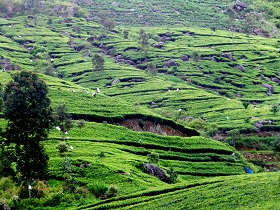 am-rolled Jonathan until he agreed that it was time to get up and start the day. We went to our fave local eatery, where they love us and seem intent on stuffing us full of delicious Sri Lankan food and tea for as long as we'll keep nodding at their re-fill offers. In the end, our bill came to a whopping total of $2.75 and we were sure we wouldn't have to eat again until dinner. The friendly bus station men led us to the exact spot in which our bus would stop and then we collected (by no effort of our own) a group of overly-helpful locals who made it their mission to ensure that we were entertained while we were waiting, and ready the second the bus pulled up in front of us. As we waited the clouds started to roll in. Boo. By the time we had paid our 20 cent bus ticket and the rickety bus had rumbled and belched its way down the cliff-hanging road of a hundred turns and deposited us in front of the factory, everything was enveloped in clouds. Up here in the hills, the sky doesn't just get cloudy, the sky actually falls around the town. We were in the clouds and mist and could visibly see cloud wisps as they blew by. It would have been great, if I hadn't known that there was something spectacular hiding out there beyond the clouds.
Travelling off season has many benefits. Lack of other tourists being the main one. We paid our $2 and set off on our private tour of the Lipton tea factory. We started up on the second floor where 10kg bags over-flowing with tea leaves were being hauled in from outside. Tea leaf collectors, all women, bring their loads in to the factory three times a day. Each woman collects about 20kg a day! During the day, the factory processes thousands and thousands of kilos of tea leaves. It takes 1kg of leaves to make 250g of bag-worthy tea! Ponder that next time you are enjoying your Orange Pekoe.
The process is fascinating. First, leaves are individually inspected for quality. Only the youngest, lightest leaves will do. They are then poured into troughs where they are aired for 16 hours with warm air from a big fan underneath. Our tour guide dug down to the bottom of the trough and let a gust of air blow up through the leaves setting them off into a dancing frenzy, blowing up into the air and swirling around us. Tea leaves scattered everywhere. Judging by the amount of tea in its various forms laying at random around the factory floor, I figured that they had some to spare. This may be a world renowned international brand, but we are still in Sri Lanka, we laughed. After they're blow dried, the tea leaves are dropped down a hole into huge barrels. More dancing ensues, as the leaves shake, rattle and roll themselves into longer stick-like form. They are cut one, two and three times down to miniscule size with a little more bouncing around in between, of course to separate the superior quality from the seconds. The tea is fired, separated again and then bounced around some more to divide the different size morsels. The best quality tea is packed up and shipped away for us westerners to enjoy. Lucky us!
Its amazing that within 24 hours tea can go from a young leaf on a branch to a black pinch of dust ready for your mug. It was also funny to walk around the factory and see all the millions of cups of tea bouncing, cooking, or just lying around. There was tea absolutely everywhere.
Af ter our lesson we left the factory to wander around some of the hundreds of acres of tea plant covered hills. Unfortunately the clouds had not lifted in the least and we could see no more than a couple hundred metres ahead of us. I was disappointed again as we started to stroll, but the spectacular atmosphere changed my tune pretty quickly. The clouds/mist itself was beautiful to walk in. The vibrant green tea plants that immediately surrounded us were a bright contrast to the opaque whiteness of the cloud and the trees that dotted the plantation looked like blurry silhouettes adding dimension to our limited view. When the clouds momentarily parted to reveal steep green mountains lined to their peaks with rows of tea plants and speckled with butterfly-like tea pickers in their colourful sarees, it was absolute magic. The scene vanished almost as quickly as it had appeared, almost as if it wasn't actually there at all.
Speaking of things appearing out of the mist, on our way back down through the hills, I turned back momentarily and my heart stopped. Was that... could it be... a gorilla emerging from the mist behind me! A gorilla in the mist! Gasp. A quick second take calmed my nerves. No gorilla... for better or worse, it was just my hairy, hairy husband bringing up the rear... haha!
ps. Ceylon tea is tea from Sri Lanka. I didn't know this. The Brits changed the name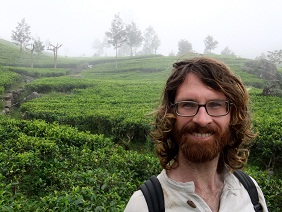 of the island (from the name the Dutch had already changed it to, from the name the Portugese had changed it to...) to Ceylon back in the day. And then they planted a bunch of tea in 'Ceylon'. Ceylon Tea! In 1972 Lankans restored their island's name to what they had always known their country as, 'Lanka', adding 'Sri' as a respectful title.
stretches from the mountain ridge that we are on in central Sri Lanka all the way down to the south coast. From our high vantage point we look out at the rolling green hills getting smaller and smaller before they eventually flatten out into plains dotted with lakes that glisten in the morning sun. What a view to wake up to!Needless to say, it appeared to be the perfect day for the hike up to Lipton's Seat- the view point that Sir Thomas Lipton, of Lipton tea, himself would climb to to survey his tea empire from. The views were meant to be breath-taking and I had been looking forward to it since I had started planning our Sri Lankan itinerary. First, though, we had to go to the Dambatenne Tea Factory, started by Lipton in 1890, and still 'growing' strong, providing Lipton tea lovers around the world with their morning cuppa for over a century. Pretty cool. Sri Lankans are proud of their tea- and rightly so- they are the world's second most important tea-growing nation, and, from experience I can say that their tea is pretty darn tastey.
I ste
am-rolled Jonathan until he agreed that it was time to get up and start the day. We went to our fave local eatery, where they love us and seem intent on stuffing us full of delicious Sri Lankan food and tea for as long as we'll keep nodding at their re-fill offers. In the end, our bill came to a whopping total of $2.75 and we were sure we wouldn't have to eat again until dinner. The friendly bus station men led us to the exact spot in which our bus would stop and then we collected (by no effort of our own) a group of overly-helpful locals who made it their mission to ensure that we were entertained while we were waiting, and ready the second the bus pulled up in front of us. As we waited the clouds started to roll in. Boo. By the time we had paid our 20 cent bus ticket and the rickety bus had rumbled and belched its way down the cliff-hanging road of a hundred turns and deposited us in front of the factory, everything was enveloped in clouds. Up here in the hills, the sky doesn't just get cloudy, the sky actually falls around the town. We were in the clouds and mist and could visibly see cloud wisps as they blew by. It would have been great, if I hadn't known that there was something spectacular hiding out there beyond the clouds.Travelling off season has many benefits. Lack of other tourists being the main one. We paid our $2 and set off on our private tour of the Lipton tea factory. We started up on the second floor where 10kg bags over-flowing with tea leaves were being hauled in from outside. Tea leaf collectors, all women, bring their loads in to the factory three times a day. Each woman collects about 20kg a day! During the day, the factory processes thousands and thousands of kilos of tea leaves. It takes 1kg of leaves to make 250g of bag-worthy tea! Ponder that next time you are enjoying your Orange Pekoe.
The process is fascinating. First, leaves are individually inspected for quality. Only the
youngest, lightest leaves will do. They are then poured into troughs where they are aired for 16 hours with warm air from a big fan underneath. Our tour guide dug down to the bottom of the trough and let a gust of air blow up through the leaves setting them off into a dancing frenzy, blowing up into the air and swirling around us. Tea leaves scattered everywhere. Judging by the amount of tea in its various forms laying at random around the factory floor, I figured that they had some to spare. This may be a world renowned international brand, but we are still in Sri Lanka, we laughed. After they're blow dried, the tea leaves are dropped down a hole into huge barrels. More dancing ensues, as the leaves shake, rattle and roll themselves into longer stick-like form. They are cut one, two and three times down to miniscule size with a little more bouncing around in between, of course to separate the superior quality from the seconds. The tea is fired, separated again and then bounced around some more to divide the different size morsels. The best quality tea is packed up and shipped away for us westerners to enjoy. Lucky us!Its amazing that within 24 hours tea can go from a young leaf on a branch to a black pinch of dust ready for your mug. It was also funny to walk around the factory and see all the millions of cups of tea bouncing, cooking, or just lying around. There was tea absolutely everywhere.
Af
ter our lesson we left the factory to wander around some of the hundreds of acres of tea plant covered hills. Unfortunately the clouds had not lifted in the least and we could see no more than a couple hundred metres ahead of us. I was disappointed again as we started to stroll, but the spectacular atmosphere changed my tune pretty quickly. The clouds/mist itself was beautiful to walk in. The vibrant green tea plants that immediately surrounded us were a bright contrast to the opaque whiteness of the cloud and the trees that dotted the plantation looked like blurry silhouettes adding dimension to our limited view. When the clouds momentarily parted to reveal steep green mountains lined to their peaks with rows of tea plants and speckled with butterfly-like tea pickers in their colourful sarees, it was absolute magic. The scene vanished almost as quickly as it had appeared, almost as if it wasn't actually there at all.Speaking of things appearing out of the mist, on our way back down through the hills, I turned back momentarily and my heart stopped. Was that... could it be... a gorilla emerging from the mist behind me! A gorilla in the mist! Gasp. A quick second take calmed my nerves. No gorilla... for better or worse, it was just my hairy, hairy husband bringing up the rear... haha!
ps. Ceylon tea is tea from Sri Lanka. I didn't know this. The Brits changed the name
of the island (from the name the Dutch had already changed it to, from the name the Portugese had changed it to...) to Ceylon back in the day. And then they planted a bunch of tea in 'Ceylon'. Ceylon Tea! In 1972 Lankans restored their island's name to what they had always known their country as, 'Lanka', adding 'Sri' as a respectful title.
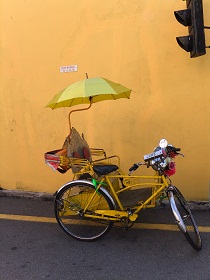
 we immediately messaged him to assist in his quest. Free accommodation and the chance of hanging out with a 'master' would just happen to be side benefits. Considering Yee Tea had three-hundred-sixty-five positive references from fellow couchsurfers, it became apparent that Tea was already well on his way to achieving his goal. Yee Tea, fittingly, owns a tea shop on the main street of the old town of UNESCO World Heritage protected area of Melaka. 'Tea talk is free' his profile read. Perfect. We found Tea's shop pretty easily. 'You want a tri-shaw ride?' asked one of the thirty-eight tri-shaw drivers standing proudly beside his contribution to the 'tackiest tri-shaw in the world' competition. Its their thing in Melaka, apparently. They deck out their tri-shaw with fake flowers, flashing Christmas lights, heart-shaped pillows and Happy Meal toys and then tourists find the idea so entertaining that they can't possibly turn down a ride. 'No Thanks, we don't need a ride.
 Our friend lives right down the street.' 'You have a friend in Melaka?' the driver asked curiously. 'Yes, he owns a tea shop.' Jonathan told him. 'Ohhhhhh,' said the tri-shaw driver, nodding, 'Yes, he has many friends.' I guess you can't host five-hundred couchsurfers without your townsfolk taking note.
 did. The old town itself, particularily Chinatown, is a fantastic jumble of narrow streets lined with shops and restaurants offering eyefuls of window-hanging meat, huge bags of meat-crackers, and colourful sarongs and paintings combined with nosefuls of smelly dried fish, barrels of mushrooms and sweet pineapple cookies.
 Chinese and Indian communities he jumped up from the table and returned with a couple of so-fresh-they-were-too-hot-to-touch chinese doughnuts (dough stretched out into long sticks and fried). 'To soak up the bottom of your soup with,' he explained. Chinese doughnuts to soak up our Indian soup. Multiculturalism at it's tastiest.
 to do with chopsticks. Then, from what we gathered, his dissatisfaction turned to something sushi related and before we knew it Fred had run into the kitchen and grabbed a large, extremely well cared for chef knife to show us how to properly cut air sushi. We think. The knife made me very uncomfortable and I quickly offered to return it to the kitchen for him. Then I hid it underneath all the dish towels at the very bottom of the very furthest drawer: this just in case Fred decided he wanted to demonstrate cutting something else in the middle of the night. When we woke up in the morning with all of our digits in tact we came to the conclusion that maybe Fred really was a nice guy who was just very passionate about chopsticks and sushi. 'What are you doing today, Fred?' I asked him on his way out the door. 'Coffee bean,' was his reply.
 be sweet - so obviously it made it to the top of my list as well. Cendol is a odd combination of shaved ice, coconut milk, green tapioca drops and local liquid palm sugar. I don't know why the tapioca needs to be green- but it is. The tapioca itself, in case you are having trouble picturing it, is like the pearls or bubbles in bubble-tea. So chewy and not super flavourful, but obviously there. The drink came out in a large icecream dish that was piled high with shaved ice and topped with sugar. In my books, anything topped with sugar and containing coconut is a-ok, but it certainly was unlike anything I had tasted before.
 special way to drink the tea.
 picture. So, really, the mess was Jonathan' fault, because he should have known better than to distract me while I was pouring. 'Tea Disaster' I was declared. Which is really unfortunate, because I thought I was capable of making quite a tasty 'cuppa' before all this.
 and life would have a direct impact on how we live day to day and how we internalize and make sense of new circumstances.
 to be so different. Again, it's so obvious that we had just taken our differences as fact and moved on.
 experiencing, or even know for sure the way someone will interpret things we do or say. This is partly why we are travelling: to widen, and mature our personal lens and, over time, become able to understand and communicate with clarity, not only our experiences, but how others might be experiencing us. Of coure this doesn't mean that we intentionally go into situations ignorantly. We do our best to read, to talk to other travellers and locals and to learn from how we see the world happening around us. But its impossible to be prepared for every single situation and know how to react perfectly to every person. People are just as varied within a culture or country as the culture is itself from the culture we know. Therefore, the more experiences we have, the more days we spend immersed in this foreign culture, the more capable (we hope) we are of understanding other people's influence on us, and ours on them. Of course we also learn and grow through talking to other travellers, who, if from the west as well, would have experiences and thought processes at least similar to our own, and therefore easier for us to understand. Lessons that can be bundled up and easily
 delivered to us via other travellers are usually of the easier of lessons, however. Harder to digest cultural differences seem to be more often learned through personal experience. The idea of learning from others, or through fellow travellers' mistakes brings up yet another issue, however. Sometimes what people are saying isn't really getting the point across that they intend to, whether because of a language barrier or just their way of explaining. And then, even if your fellow travellers do manage to successfully communicate their point, it's not necessarily the case that you will interpret the information the way it is intended. Although, I suppose these are general issues with communication and not necessarily specific to travel. Nonetheless, that doesn't lessen the value of the experiences and systems of thought foreign to us either. Nor should it be an avenue deemed to offer no or even limited opportunities for growth and maturation. Quite the contrary, in fact. Still, though, tips, advice, stories and tall tales are internalized through that lens of ours. No matter how open one is to seeing the 'real' world it is impossible to see anything any other way than through what they already know or hold as true. One of the reasons we love travel so much is it's unabashed opportunity to learn. We've said before, and strongly believe that engaging with real life and real experiences are the best way to learn about the people, places and cultures. We have noticed significant changes in ourselves over the last three and
 a half months. Our experiences and knowledge have widen our horizons considerably and, no doubt, how we are experiencing Thailand today (we are posting this from Thailand) is through an enlarged and not-quite-the-same framework than we would have been able to experience it two months ago. Still, we are new, and, clearly, have a lot to learn.