Central North Island is all about shaking and jiving. Of the earth's plates that is.  You can smell that you are approaching Rotorua before you can see it. That eggy sulfur aroma fills your nostrils and you know you are in the land of sizzling streams, smoking lakes and exploding mud (either that or you are dangerously close behind Uncle Dan). Rotorua has always been revered by the Maori (NZ's indigenous population) and today 35% of the it's population is Maori. There is an interesting Anglican church in a traditional Maori village called Ohinemutu inside Rotorua which has successfully integrated ancient Maori traditions (mainly
 carvings in building structure) with Christianity. In the village was also a traditional meeting hut along with various other beautifully detailed Maori carvings. After exploring the church we went for the cheap geo-thermal thrills in Kuirau Park. Most of the geysers and hot pools in the area are on privately owned land and therefore cost money to see. Kuirau Park is right in the centre of town for all to admire. This volcanic area has a large steamy crater lake, several pools of boiling mud and a couple hot mineral baths for dipping. The most
 recent eruption in the Park was in late 2003 which left most of the park, including the trees covered in mud! Fortunately/unfortunately there was no such mud bath during our visit.
We headed further south to Taupo, the crater of a massive volcano disguised as a lake. After milling about the lake for a bit we headed into town and, seeing Merrells on sale, found ourselves in an outdoors store. Barry, the young Kiwi sales assistant was knowledgeable and friendly, telling us all about the surrounding area, the volcanoes in Tonganariro National Park, and the benefits of Merino wool socks. He told us that the volcanoes are still very active and in 2007 a small earthquake accompanied the eruption and a poor hiker in a hut on the mountain lost his leg when lahar (like lava) flew through the door! Jeez Louise!
Before venturing into volcano land, we indulged our sweet tooth at the Honey Hive. This magnificent store had active bee hives in glass enclosures, bee stats, bee movies, bee books, and, most importantly honey. Of the free sampling variety.What a delicious way to spend and hour... or two. Did you know that a worker bee (always infertile females) only live about 6 weeks and make a
  total of 1/2 teaspoon of honey over their entire lives?!
Next to the Honey Hive was Huka Falls. 22,000 litres of water every minute cascade dramatically over 10m into a swirrling pool. Its not quite as magnificent as Niagara, but it lacks the suffocating hotels and tacky souvenir shops, which is a major bonus. The water is moving so fast that the falls is a beautiful aqua colour, a result of the massive amount of oxygen mixed with the water.
We were lucky enough to learn about a free campsite besid e a emerald green river and headed there for the night. There was a sign at the entrance that said the site didn't open until Nov 1st. It was Oct 29th, but the camp was quite busy. Jonathan went on a quest to get to the bottom of the situation and returned with new Kiwi friends Bill and Lindy. And Lindy arrived with cake for us! Delicious home made ginger and coffee cakes, which we devoured for dessert. Such treats are of high demand in these parts, we discovered when a dozen tiny ducklings bravely waddled up to our feet and did
  what I'm sure was their best attempt at puppy eyes. Who can say no to cute little fluffy ducklings begging for just the tiniest bite of cake and a cuddle. Who are we trying to kid. I can. This is cake we are tallking about here. Ducks eat weeds, not cake. (My aunts are now saying 'awwwwwww, Kristen is so mean!') Anyways, Bill explained that this perfect campsite had been left to the community as a free campsite in a will. Since then the township has been trying to close it down, but for some legal reasons they can't. Yaa for the law!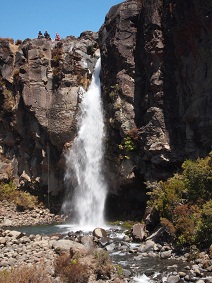
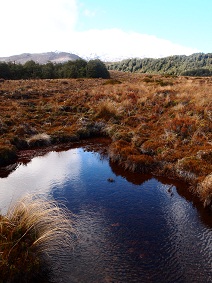
We ventured into the Volcano lair the next day. The three peaks of Tongariro National Park were a gifted to NZ in 1887 by the local tribe who saw this as the only way to preserve the area of spiritual significance. This makes Tongariro NZ's first National Park and the fourth National Park in the World. We spent 2 days hiking in the mountains. Other than the volcanoes we saw stunning waterfalls, gold coloured streams, a river adorned with dozens of inukshuks and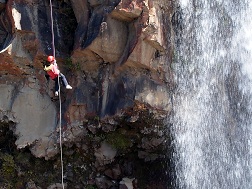 water flowing through cream terraces. On one hike, on a relatively sunny afternoon we felt a cold breeze blow over us, and low and behold, it was snowing. Not huge flakes or swirrling gales, but beyond a doubt, snow. Last week I was in my bathing suit on a beach and today it is snowing. It was magical. Until Jonathan started humming ' Walking in a Winter Wonderland.' Camping is cold when you are in the mountains, it turns out. After putting
  on every single piece of clothing we had, and still not getting a wink of sleep we jumped into the front seats, put the defrost on full blast (which we needed, because there was frost on the INSIDE of the van) and took off in search of sun to warm our bones. Its amazing what a difference a bit of warm morning sun can make.
From the Park we headed to Windy Wellington, the Nation's Capital on the southern tip of the North Island. There were flags everywhere 'Wellington-Named by Lonely Planet as the Best Little Capital on Earth' or something like that. And it was impressive. Wellington has a huge magnificent harbour, beautiful beaches and lots of walk ways all right downtown. Like in Vancouver, everyone we saw
  looked fit and practically glowed of good health. Intimidating. Do they even sell ice cream here? Because I can't find any. Our first port of call was the National Museum, 'Te Papa' which loosely and affectionately translates to 'Our Museum.' Fitting. Te Papa is hugely interactive. You can touch, play with, light up, listen to or watch in 3D almost every exhibit. Plus, it's free.
 Our guide book says the museum is an 'innovative celebration of the essence of NZ' which sounds about right. Te Papa has the world's only Colossal Squid on display along with Maori art, lively displays of NZ culture over the decades, photography, trees, birds, sea life, geography and geology. Fascinating.
NZ fact: Similarities in language between Maori and Tahitian indicate close contact in historical times. Maroi is about as similar to Tahitian as Spanish is to French, despite the 4294km separating these island groups!
NZ fact: The Mouse that Roared: In 1984 Prime Minister David Lange barred nuclear -powered or armed ships from entering NZ waters. As a result the US threw NZ out of ANZUS, the country's main strategic military alliance which also included Australia , delaring NZ 'a freind but not an ally.' In 1987 the idea became law with the 'Nuclear Free Zone, Disarmament & Arms Control Act.' NZ continues to demonsrate it's conscience through it's current un-involvement in Iraq.
You can smell that you are approaching Rotorua before you can see it. That eggy sulfur aroma fills your nostrils and you know you are in the land of sizzling streams, smoking lakes and exploding mud (either that or you are dangerously close behind Uncle Dan). Rotorua has always been revered by the Maori (NZ's indigenous population) and today 35% of the it's population is Maori. There is an interesting Anglican church in a traditional Maori village called Ohinemutu inside Rotorua which has successfully integrated ancient Maori traditions (mainly carvings in building structure) with Christianity. In the village was also a traditional meeting hut along with various other beautifully detailed Maori carvings. After exploring the church we went for the cheap geo-thermal thrills in Kuirau Park. Most of the geysers and hot pools in the area are on privately owned land and therefore cost money to see. Kuirau Park is right in the centre of town for all to admire. This volcanic area has a large steamy crater lake, several pools of boiling mud and a couple hot mineral baths for dipping. The most recent eruption in the Park was in late 2003 which left most of the park, including the trees covered in mud! Fortunately/unfortunately there was no such mud bath during our visit.We headed further south to Taupo, the crater of a massive volcano disguised as a lake. After milling about the lake for a bit we headed into town and, seeing Merrells on sale, found ourselves in an outdoors store.
Barry, the young Kiwi sales assistant was knowledgeable and friendly, telling us all about the surrounding area, the volcanoes in Tonganariro National Park, and the benefits of Merino wool socks. He told us that the volcanoes are still very active and in 2007 a small earthquake accompanied the eruption and a poor hiker in a hut on the mountain lost his leg when lahar (like lava) flew through the door! Jeez Louise!Before venturing into volcano land, we indulged our
sweet tooth at the Honey Hive. This magnificent store had active bee hives in glass enclosures, bee stats, bee movies, bee books, and, most importantly honey. Of the free sampling variety.What a delicious way to spend and hour... or two. Did you know that a worker bee (always infertile females) only live about 6 weeks and make a total of 1/2 teaspoon of honey over their entire lives?!Next to the Honey Hive was Huka Falls. 22,000 litres of water every minute cascade dramatically
over 10m into a swirrling pool. Its not quite as magnificent as Niagara, but it lacks the suffocating hotels and tacky souvenir shops, which is a major bonus. The water is moving so fast that the falls is a beautiful aqua colour, a result of the massive amount of oxygen mixed with the water.We were lucky enough to learn about a free campsite besid
e a emerald green river and headed there for the night. There was a sign at the entrance that said the site didn't open until Nov 1st. It was Oct 29th, but the camp was quite busy. Jonathan went on a quest to get to the bottom of the situation and returned with new Kiwi friends Bill and Lindy. And Lindy arrived with cake for us! Delicious home made ginger and coffee cakes, which we devoured for dessert. Such treats are of high demand in these parts, we discovered when a dozen tiny ducklings bravely waddled up to our feet and did what I'm sure was their best attempt at puppy eyes. Who can say no to cute little fluffy ducklings begging for just the tiniest bite of cake and a cuddle. Who are we trying to kid. I can. This is cake we are tallking about here. Ducks eat weeds, not cake. (My aunts are now saying 'awwwwwww, Kristen is so mean!') Anyways, Bill explained that this perfect campsite had been left to the community as a free campsite in a will. Since then the township has been trying to close it down, but for some legal reasons they can't. Yaa for the law!We ventured into the Volcano lair the next day. The three peaks of Tongariro National Park were a gifted to NZ in 1887 by the local tribe who saw this as the only way to preserve the area of spiritual significance. This makes Tongariro NZ's first National Park and the fourth National Park in the World. We spent 2 days hiking in the mountains. Other than the volcanoes we saw stunning waterfalls, gold coloured streams, a river adorned with dozens of inukshuks and
water flowing through cream terraces. On one hike, on a relatively sunny afternoon we felt a cold breeze blow over us, and low and behold, it was snowing. Not huge flakes or swirrling gales, but beyond a doubt, snow. Last week I was in my bathing suit on a beach and today it is snowing. It was magical. Until Jonathan started humming ' Walking in a Winter Wonderland.' Camping is cold when you are in the mountains, it turns out. After putting on every single piece of clothing we had, and still not getting a wink of sleep we jumped into the front seats, put the defrost on full blast (which we needed, because there was frost on the INSIDE of the van) and took off in search of sun to warm our bones. Its amazing what a difference a bit of warm morning sun can make.From the Park we headed to Windy
Wellington, the Nation's Capital on the southern tip of the North Island. There were flags everywhere 'Wellington-Named by Lonely Planet as the Best Little Capital on Earth' or something like that. And it was impressive. Wellington has a huge magnificent harbour, beautiful beaches and lots of walk ways all right downtown. Like in Vancouver, everyone we saw looked fit and practically glowed of good health. Intimidating. Do they even sell ice cream here? Because I can't find any. Our first port of call was the National Museum, 'Te Papa' which loosely and affectionately translates to 'Our Museum.' Fitting. Te Papa is hugely interactive. You can touch, play with, light up, listen to or watch in 3D almost every exhibit. Plus, it's free. Our guide book says the museum is an 'innovative celebration of the essence of NZ' which sounds about right. Te Papa has the world's only Colossal Squid on display along with Maori art, lively displays of NZ culture over the decades, photography, trees, birds, sea life, geography and geology. Fascinating.NZ fact: Similarities in language between Maori and Tahitian indicate close contact in historical times.
Maroi is about as similar to Tahitian as Spanish is to French, despite the 4294km separating these island groups!NZ fact: The Mouse that Roared: In 1984 Prime Minister David Lange barred nuclear -powered or armed ships from entering NZ waters. As a result the US threw NZ out of ANZUS, the country's main strategic military alliance which also included Australia , delaring NZ 'a freind but not an ally.' In 1987 the idea became law with the 'Nuclear Free Zone, Disarmament & Arms Control Act.' NZ continues to demonsrate it's conscience through it's current un-involvement in Iraq.

 Although its only a few hours from Auckland, it feels like an isolated world away.
 We stopped in the dramatic Coromandel Forest Park to take in the mountains and then headed straight for the top. Since there was 35km of windy, steep gravel road between the last town and the campsite at the tip of the peninsula, we decided to go stay at the 'closer' campsite, only 28km down the gravel road.
  Now 28km is not far, say, between Niagara and St. Catharines, but let me tell you, 28 km down a NZ gravel road takes at least an hour. We bump and swerve along as camper-vans twice our size try to squeeze between us (driving on the left, keep in mind) who are dangerously close to the edge of a guard-rail-less cliff and the steep mountain side which is hemming them into our lane. Or their lane. Who can tell really. There probably only is the one lane.
  Anyways. We arrived safely at the site to only to remember that it is a NZ long weekend. Labour Weekend. The site is packed to the gills with elaborte camp fortresses, beer drinking men and screaming children. Ahhh camping is so relaxing. We squeeze ourself into a little alcove wondering how this gem of a (almost) private area could still be available. What did we miss? In NZ at these Department of Conservation sites there is generally a grassy area, or serveral grassy areas that you simply drive on to, stopping to camp where-ever suits your fancy. We grabbed our chairs and headed to the rocky beach to watch the fisher-people, kayakers, scuba divers and the sunset.
 Port Jackson is a 2km beach with camping on the small dunes, just our of reach of those nasty high tides. It is perfect. We set up our little campervan (aka:parked it) in a little spot between two native Puka trees, right smack dab on the ocean. And what to our wandering eyes do appear? Killer whales breeching in the bay! At least 3! Maybe a pod! We watch them in wonderment when our camping neighbour comes over to make sure we see them. He says that they come almost everyday and sometimes they ever sweep in around close to shore! And do we want some fresh water to fill up our jug?
 Jonathan goes to brush his teeth and doesn't come back for an hour. But I'm not worried. Between the exuberant Kiwi friendliness and Jonathan's need to smile and say 'hi' to everyone, including passing livestock, (isn't it great how lovingly Kristen portrays me in these stories?) we have a recipe for hours and hours of distraction. Needless to say, he returns to our heavenly site with stories of lore from Terry, a Kiwi luger.
 Terry was on the 1989 NZ Olympic luge team at the Calgary Olympics. It is amazing in itself to have made it to the Olympics. That celebrated accomplishment is one shared by every individual who competes in the games, winter or summer. The dedication to training and exercising needs likely to be borderline fanatical for an athlete to be in peak physical condition so as to respond as efficiently as possible to the twists and turns and all the challenges wrought with high speed, high adrenaline and high pressure sporting. The sheer determination that pushes every athlete into the Olympics can't be denied. Imagine the blood, sweat and tears that every Canadian Olympic slalom skier parted with to raise her or his game to the level they did. But without taking away any of that, Terry competed at the winter Olympics in luge and comes from a tropical island.
  Jamaican bob-sled team, anyone? He trained incredibly hard for two years by putting four shopping cart wheels on a sled and drove across the whole of New Zealand just to climb a new hill and sled (or luge) down it. After knowing and experiencing luge as solely a summer sport, Terry's soon-to-be coach approached him and asked if he knew some countries in the world only knew luge to be a winter sport...with snow and ice. Needless to say it didn't take Terry much convincing and he had flights booked all of Europe and even Canada to have a go with blades on his sled rather than shopping cart wheels (I don't know how his particular wheels were, but aren't those ones that spin around and do everything except roll pretty annoying?). He was such an enthusiastic story-teller.
  And he was very generous too: by the end of our chat he was asking if Kristen and I wanted to swing back around here at Christmas so that he and his family could have us as guests! Like Charlie describing the chocolate factory, Terry told me the yearly tradition at Port Jackson. Supper is brought in from the sea. Intensely rich pauas (pronounced "pow-ahs") (shell fish) are collected by the hundreds and cooked in butter. A pig is put on a spit. Fish, most often Red Snapper is brought in by the kilogram from the sea and filleted. Every family there would bring a banquet size table and all would be put together into one massive
  communal dinner table where everyone eats together and shares what they have. Apart from the fact that there didn't sound like a single vegetable made it to this feast, it sounded like an experience we would only have been too lucky to have been apart of. It was more than good enough for us that we were even invited.
 Since we could't bare to leave our perfect spot, and it's Holiday Monday and no one wants to travel on a Holiday, we decide to stay another day. Not a hard decision. We go on the short hike to the lookout over the bay (and to Channel Island!) that everyone keeps telling us about. Then, remembering that I saw some open kayaks by the Ranger Station we decide to ask the friendly ranger couple if we could rent them. 'No, you can't rent them.' Awwwwwwww 'But you can borrow them, for free.' This is the best day of my life. We cross our fingers that the orcas are skipping the beach today. We are geeks
  and love nature shows. Unfortunately we have seen one too many shows where killer whales and sharks mistake kayakers for seals, a favourite snack, and it makes for what looks like a painful paddle. Hoping we didn't bite off more than we can chew, (haha!) we pulled the bright yellow and orange kayaks across the sand (and there is a lot of sand at low tide) and set off into the impossibly clear ocean in search of sea-life (the non-threatening kind). I was thinking of how jealous my mom would be and loving every second of it. (The kayaking, not the bragging, of course) We were out for 3 hours! I was giddy with excitement, and a healthy dose of fear, as we paddle through every nook and cranny, between every rock and into every seaweed patch. We saw loads of spiky sea urchins,
  pink jellyfish and, the highlight: a sting ray! We return `home`and, after a pancake dinner, had a campfire with wood that our neighbours had left behind. As soon as the sun goes down the kill becomes filled with stars. The kind that even twinkle. Its a truly spectacular sight.
 Anyways, because NZ sits on a hot plate they have a variety of cool geo-thermal activities. Two hours on either side of low tide you head down to a certain part of the adequately named `Hot Water Beach`, with a shovel and you can dig your own hot tub! I dragged Jonathan down onto the sand, which already had a number of people enjoying the self-made hot tubs. Thankfully for us, since we forgot to pack our shovels (I knew there was something I forgot!) some nice people had dug a few holes, which had filled with water and since left. We picked a pool with an unobstructed view of the water. The water was HOT.
  Hotter than even A. Maryann would want the hot tub. My skin was red instantly and Jonathan barely ventured his little butt down into the pool. Not to be discouraged, since this was too fantastic to pass up, I moved from rejected pool to rejected pool until some Kiwi guys about our age, probably out of pity, yelled 'Second hand pool for sale!' looking right at me. And so, before they even collected their empty beer bottles from the sand, I jumped into their perfectly temperate, perfectly deep, perfectly perfect hot tub and refused to budge until the tide finally came in and booted me out. Stupid tide. Got me again. All good things come to an end though, or so they say. I don't know about that quite yet though. We still have a whole lot of NZ in front of us!
 Ok, everyone. Time to get out your atlas and follow along. We left Auckland and headed north to the magical, whimsical Northland. It is that tiny finger of land that juts so far out into the pacific that you wonder how it is still attached. Because NZ is upside down and backwards, the North is warm and the south is cooler. We were headed to the land of white sand beaches, crystal clear turquoise water, frolicking dolphins and roadside avocado stands. This is the stuff dreams are made of.
 White sand beach after white sand beach with no one there except for interesting little oyster catchers (a shore bird). We fell asleep under our huge sunroof gazing at the Southern Cross for the first time. (The southern cross is a constellation you can only see in the Southern Hemisphere.) Ahhhhhhh.
 There was a cliff walk that I really wanted to do at the Mangawhai Heads. 'Magical Mangawhai' is what the official roadside sign says. This gives me reasonably high expectations. If the government says this is magical, really who can argue? We stopped at tourist information. It was closed. It is part time. We read the 'full time' information posted on the bulletin board.
  It informed us that the return of our hike would not be possible across the beach at high tide. What does this mean?
  There was no diagram of the hike. There was no tide time table. We do not all live on an island in the Pacific, New Zealand. Some of us haven't thought about tides since grade 8 environmental studies. Oh well. They would make it REALLY obvious if this hike at this time was a bad idea. There would be lifeguards around somewhere watching for stupid land-locked tourists like us. We drove down to the beach. The sign warned again: 'No return via beach at high tide.' No tide-table, no diagram. Useless. Whats the worse that could happen? We take off our shoes and wade along the beach for a bit. Our feet were getting stinky anyways. No worries. We started out along the beach.
  Unfortunately, although this cliff walk started at the beach, at ground level, it involved hiking first to the top of the cliff before being rewarded with the spectacular view. We were on the top of a cliff. What did tides matter? Tides can't get us here! Safe! So we sauntered along. There were subtle transformations to the view around every bend and I made it my duty to capture each change. Each tree, each angle, each flower were adequately documented.
  This took some time. We came to a sign after about an hour and a half. There were 2 arrows. One pointed back the way we came from. 'Home via cliffs- 1.5 hours' Boring! We had just come from that way. I much prefer loop hikes. Thankfully the other arrow pointed the opposite direction 'Home- via beach' and yet again, 'Not possible at high tide.' Jonathan said he would be fine carrying his shoes along the beach, if it were in fact, high tide.
  A fact that is apparently a big secret in 'Magical Mangawhai.' Maybe the the tides were magic? Anyways, 2 hours really wasn't that longer than 1.5 hours. We crossed our fingers. The trail continued along the cliffs a while longer and then we went down, down, down a million step and steep ramps to get back down to sea level. 'Hope we don't have to climb back up these' Jonathan said, knowing that if we did he would have one cranky, sweaty, whiny wife crawling up the stairs behind him alllll the way back up.
 We could tell that we were probably going to have to turn around when we were about 3/4 the way down the stairs, but in disbelief I insisted on going ALL the way down to see if maybe there was a secret or 'magical' passage way behind the cliffs. There was not. I wish I could say (for my darling husband's sake) that I chuckled and smiled and said ' Aw, oh well! Lets chalk that one up to experience, eh dear? Too bad we have to climb ALL the way back up those 5 gagillion stairs.
  But, you know, that's ok! Exercise is good for me!' But, alas, this did not happen either.
 The Ranger came by our van one morning. We were staying at this gorgeous site and 5 meters from the beach of a wide harbour, right around the bend from the open ocean. 'You up?' I opened the door and the poor Ranger got a glimpse of my dear Jonathan sans shirt, barely awake, squinting into the sun. Guess he should have seen that coming. Hope he couldn't smell his breath. 'Sure,' I say. 'Sorry, I wouldn't wake you but we just got a call.
  There's a tsunami warning,' the Ranger informs me. 'Don't worry though. Nothing serious. Something off South America. The warning is for the whole country. North and South Island. We will keep you posted. If it gets bad we will have to drive to 30m, at the top of that hill over there.' He points to a hill behind us. Jonathan decides maybe he should be awake. There is an awkward pause. The ranger is still standing there. These kiwis and their friendliness. Now is not the time for friendliness!
  It is a time for action. There is a non serious(?) Tsunami on the way. 'Sooooo..' I say and we chatter for a few more minutes, ignoring the potential impending doom.
 We got a call from the boss. There was word that there had been a dolphin caught in a net out in the harbour and he wanted to know how we got on. It wasn't a dolphin, I had to clarify, it turned out to be a diver!'
 'Oh no,' says the Ranger. 'it turned out that a diver was caught WITH a net and he had caught way over his limit of scallops!' And with that he was off to warn the others. Like I said. I think these Kiwis like to play telephone.
 They had it wrong. The tsumai warning isnt for t he whole island. Its just for the Northland, North Island, east coast.' He smiles. I look at Jonathan. 'Isn't that EXACTLY where we are? Northland, North Island, east coast?' This should be good. 'Wanna head to the west coast?' I ask Jonathan.